
Introduction
“Everything in my life seems fine. So why can’t I get pregnant?”
Many women say this in the consulting room, often with tears they have been holding back for months. If this sounds like you, please know it is not your fault. Female infertility is common, and in most cases there is an explanation. Understanding the possible causes is the first step, and it is also the first step towards finding the right infertility treatment in Ahmedabad for your situation.
What Does Female Infertility Actually Mean?
Doctors usually call it infertility when a couple has not conceived after one year of regular, unprotected intercourse. If the woman is 35 or older, the wait is shortened to six months.
It does not mean you can never have a baby. It simply means something may be getting in the way, and it is worth finding out what.
Why Is Ovulation So Important?
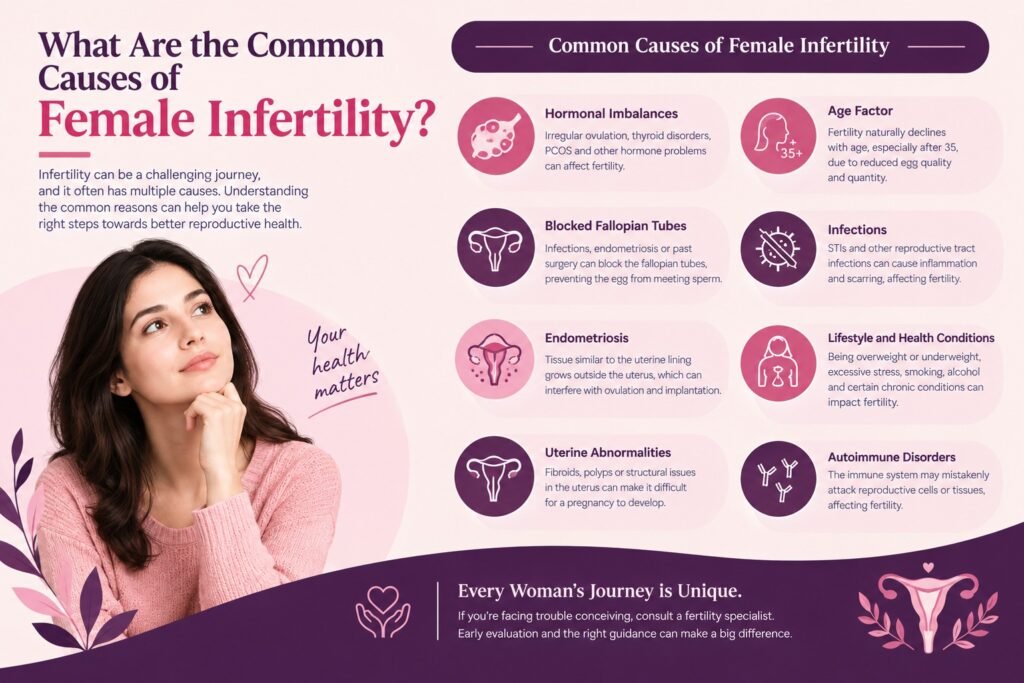
Ovulation is the monthly release of an egg from the ovary. No egg means no pregnancy, so problems here are among the most common causes.
You might have an ovulation issue if:
- Your periods are irregular, very late, or missing
- Your cycle length changes a lot from month to month
- You have very light or very heavy bleeding
Hormone imbalances, stress, sudden weight changes, and thyroid conditions can all upset ovulation. The good news is that medicines can often restart it.
Is PCOS a Common Reason for Not Conceiving?
Yes, very much so. PCOS, or polycystic ovary syndrome, is a hormone condition that affects many young women in India.
Signs can include:
- Irregular periods
- Acne or oily skin
- Extra hair growth on the face or body
- Weight gain, especially around the belly
- Thinning hair on the scalp
In PCOS, eggs do not mature or release regularly. Many women with PCOS conceive with lifestyle changes and ovulation medicines. Others may need IUI or IVF, depending on the case.
How Do Blocked Fallopian Tubes Affect Pregnancy?
The fallopian tubes are thin pathways that carry the egg from the ovary to the womb. Sperm meet the egg inside these tubes.
If a tube is blocked or scarred, the two cannot meet. Common causes include past pelvic infections, tuberculosis of the genital tract, earlier surgeries, and previous ectopic pregnancy.
There is often no warning sign. A simple test called an HSG, which is an X-ray with dye, can check if the tubes are open.
Can Endometriosis Make It Hard to Conceive?
Endometriosis happens when tissue similar to the womb lining grows outside the womb. It can settle on the ovaries, tubes, or other parts of the pelvis.
Watch for these signs:
- Painful periods that get worse over time
- Pain during intercourse
- Long-lasting pelvic pain
- Heavy bleeding
Not every woman with endometriosis has pain, though. Some find out only when they struggle to conceive. Treatment may involve medicines, laparoscopic surgery, or assisted methods like IVF.
Do Womb Problems Like Fibroids Matter?
They can. The womb needs to be a healthy, welcoming place for an embryo to settle.
- Fibroids: These are non-cancerous lumps in the womb muscle. Depending on their size and position, they may interfere with implantation.
- Polyps: Small growths on the womb lining.
- Uterine septum: A band of tissue dividing the womb, present since birth.
- Scarring inside the womb: Sometimes caused by infections or repeated procedures.
A pelvic ultrasound usually shows most of these. Many can be removed with a short, minimally invasive procedure.
Does Age Really Change Fertility?
It does, and it helps to talk about it openly. Women are born with all the eggs they will ever have. Both the number and quality of eggs decline over time, more noticeably after 35.
This does not mean pregnancy is impossible later. It means time becomes more valuable, and earlier consultation helps. A blood test called AMH gives an idea of your egg reserve.
Can Thyroid, Weight, and Stress Play a Role?
Quietly, yes. These factors are often overlooked.
- Thyroid problems: Both an underactive and overactive thyroid can disturb periods and ovulation.
- Being overweight or underweight: Body fat influences hormone levels.
- High prolactin: A hormone that, when raised, can stop ovulation.
- Long-term stress and poor sleep: They may not cause infertility alone, but they can make things harder.
Simple blood tests can check these, and treatment is usually straightforward.
How Is the Cause Found, and What Does Infertility Treatment in Ahmedabad Involve?
A good fertility check-up starts with a conversation about your periods, health history, and any past illnesses or surgeries. Then tests follow, such as:
- Hormone blood tests, including thyroid and AMH
- Pelvic ultrasound
- HSG to check the tubes
- Semen analysis for your partner, because male factors contribute in many couples
Treatment depends on what is found. It may include lifestyle guidance, ovulation medicines, treatment of PCOS or thyroid problems, surgery for fibroids or endometriosis, IUI, or IVF. Many women need only the simpler steps.
A caring specialist will explain each option clearly, including costs and success chances, without rushing you.
Final Thoughts
Female infertility has many possible causes, but almost all of them can be identified and managed. Having a cause is not a failure. It is simply information that helps your doctor guide you better.
If you are looking for dependable infertility treatment in Ahmedabad, the team at Shree Shreeji Women’s Hospital is here to listen, evaluate you and your partner carefully, and walk beside you at every stage.
You do not have to wait any longer for answers. Book a consultation today and take that first step with confidence.